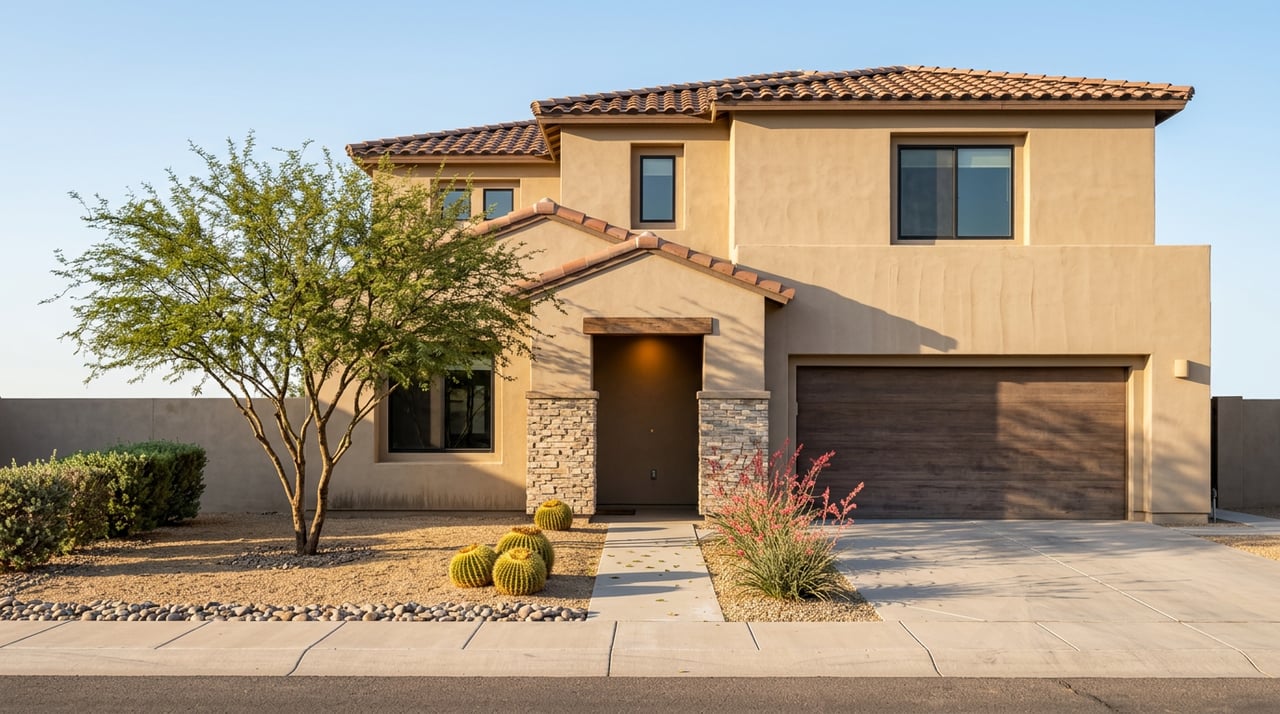
A buyer comparing two similar houses in the same part of the valley this month will often find the cheaper one on paper costs more every month. That is not a typo and it is not bad math on the buyer's part. It is what happens when one seller is cutting a price and the other is cutting a rate, and only one of those levers actually moves the monthly payment very much right now.
Here is the shape of it. Las Vegas Realtors reported a median price of $475,000 for existing single-family homes sold in August 2026, down 1% from August 2025 and off the record $490,000 set in May and June. The Las Vegas Sun reported that LVR President George Kypreos described the year's pattern plainly, saying local home prices have "been pretty stable this year, and really for the past two years or so." Stable prices sound like good news for anyone hunting a deal. But the number that moved more in the last two weeks was not the median price. It was the rate.
What Happened to Rates Between Late August and Mid-September
Freddie Mac's benchmark 30-year rate sat at 6.66% as of August 27, 2026. By September 10, Mortgage News Daily's daily index had pushed the average top-tier 30-year fixed rate above 7%, to 7.07%, up from 6.97% the day before. That is a meaningful jump in under two weeks, and it landed right as fall inventory was climbing across the valley. A buyer working off a rate quote from three weeks ago is already working off stale information.
This is exactly the gap that new-home builders are stepping into. When the market rate moves, a resale seller has one tool: the price. A builder with a captive mortgage arm has a second tool that resale sellers do not carry, which is the ability to buy the rate down directly and absorb the cost across a large pipeline of homes rather than a single sale.
The Resale Seller's Move Is Usually a Price Cut
Watching active listings across the valley this fall, the typical price reduction a resale seller makes when a home sits too long has run around $10,000. That is a real discount, and it helps. But run it through a mortgage calculator and the monthly payment barely moves, usually somewhere in the neighborhood of $50 to $60 a month on a loan in the $400,000 to $500,000 range at current rates. A buyer chasing that discount is often trading a few weeks of extra shopping for a payment that looks almost identical to the one they would have had at the original price.
The Builder's Move Is a Rate, Not a Price
National builders active in the valley have been running a different kind of promotion. The specific numbers rotate every few weeks and any given offer can expire before a reader finds it, so the pattern matters more than any single rate quoted here. In the first two weeks of September, the offers tracked across major builders fell into a few consistent shapes: permanent rate buydowns pushing the note rate into the high 4s or low 5s for the life of the loan, temporary step buydowns that start two to three points below market and climb back to the full rate over three to five years, and promotional fixed-rate FHA financing running well under the Freddie Mac benchmark. Pulte, for example, has advertised reducing a buyer's rate to as low as 1.99% in the introductory year on select homes when financed through its own mortgage company, a program with its own eligibility rules and closing deadlines. Century Communities, Toll Brothers, Tri Pointe Homes, and Richmond American have each run comparable buydown or closing-credit events through their preferred lenders this fall.
Here is why that lever moves the needle more than a price cut. A permanent buydown of even one percentage point on a $400,000 loan is worth more in total interest saved over a normal hold period than a $10,000 reduction in purchase price, because the buydown compounds every month for as long as the loan is outstanding. A price cut is a one-time event. A rate buydown is a monthly event that keeps paying out.
To see how that plays out on paper, take a resale priced at $480,000 with a market rate around 6.75% and no seller credits, against a new build priced at $520,000 with a builder-funded rate near 4.9% and roughly $12,000 in closing credits, both with the same down payment. The principal and interest on the resale lands in the low $2,900s a month. The new build, despite the higher purchase price, comes in a few hundred dollars a month lower. The house with the bigger number on the sign is the one with the smaller number on the mortgage statement.
| Resale example | New-build example | |
|---|---|---|
| Purchase price | $480,000 | $520,000 |
| Rate | ~6.75% market rate | ~4.9% builder-funded buydown |
| Seller-side help | None assumed | ~$12,000 in closing credits |
| Monthly principal and interest | Low $2,900s | A few hundred dollars lower |
Why Southwest Las Vegas Feels This the Most
This tension is not evenly spread across the valley. It is sharpest in the southwest, where established master-planned communities like Mountain's Edge, Rhodes Ranch, and Southern Highlands sit close to newer construction from builders including KB Home, Lennar, Pulte, and Century Communities. The corridor around Sunset and Durango has kept building out through 2026, with the Life Time Fitness health club under construction and IKEA already anchoring the area since 2016.
That proximity means a resale seller in the southwest is not just competing against the house down the street. They are competing against a builder sales office a few minutes away offering a rate their listing cannot match with a price cut alone. Some resale sellers have started responding the same way builders do, offering to fund a buyer's rate buydown directly instead of dropping the price further. It is a smaller shift than a builder's captive-lender program, since it depends entirely on the seller's willingness and the size of the offer, but it shows the same underlying math reaching the resale side of the market.
The Catch: This Math Rewards Staying Put
None of this makes new construction the automatic winner. The buydown math above assumes a buyer keeps the loan long enough for the monthly savings to add up, generally several years or more. A temporary step buydown that starts at 2.99% and climbs to 5.99% by year four saves real money early and then resets, so a buyer who plans to sell or refinance in year two is paying for a discount they will not fully use. A resale seller's straight price cut, small as it is, carries no expiration date and no lender restriction.
Builder incentives also usually require financing through the builder's preferred or affiliated lender to unlock the advertised rate. That can mean a tighter closing timeline and less room to shop the loan itself, even while the headline rate looks better than anything a resale seller is offering. A resale buyer, by contrast, can generally use any lender they choose, which gives more room to negotiate the loan terms even if the seller's price concession is smaller.
What to Ask Before You Compare Two Offers
- Ask whether the builder's advertised rate is permanent or temporary, and if temporary, what it steps up to and when.
- Get a quote from an independent lender and compare it line by line against the builder's captive-lender quote, not just the headline rate.
- Ask your agent to pull recent closed comps in that specific community to check whether the base price already reflects the cost of the incentive.
- If you are looking at resale, ask whether the seller would consider funding a rate buydown instead of, or alongside, a price reduction.
- Confirm how long you plan to keep the loan before deciding which structure actually saves you money.
Quick Answers
Is the builder's advertised rate the rate everyone actually gets? Not automatically. These promotions typically apply to specific inventory homes, specific closing windows, and require financing through the builder's preferred lender. The rate that shows up in an ad is a starting point for a conversation, not a guarantee for every home in the community.
Can a resale buyer ask for a rate buydown instead of a price cut? Yes. It works the same way a closing-cost credit does. The buyer or their agent asks the seller to contribute a set dollar amount toward buying down the rate, and the seller decides whether that is worth more to them than lowering the price outright.
Does bringing a buyer's agent to a new-construction purchase cost extra? Developers typically pay the buyer's agent commission themselves, so representation on a new-construction purchase generally does not add to what you pay the builder.
If you are trying to run this math on an actual house rather than an example, that is the kind of comparison our team walks through with buyers across Las Vegas, Henderson, Summerlin, North Las Vegas, and Paradise every week right now. And if a new home is only half the equation because you also need to sell the one you are in, Flat Fee Pros lists it for a flat $1,999 instead of a percentage commission, so the money you save on the sale can go toward whichever side of this comparison makes sense for you.
This article is general information, not legal, tax or financial advice. Consult a qualified professional about your situation.